| |
It can be a very daunting
experience...
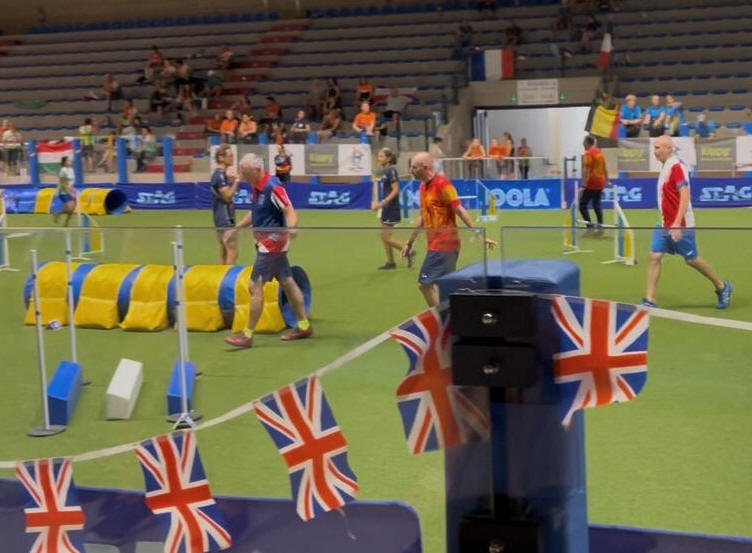
Dog agility is a fast-paced, mentally demanding sport for
both dog and handler. While your dog must navigate jumps, tunnels and contact
obstacles, you must remember the entire course, guide your dog with clear cues
and stay one step ahead. For many handlers, the biggest challenge isn’t the
running. It’s memorising the course in the first place. Competitor, trainer and
judge Lisa Jordan shares some effective, handler-tested strategies to help you
confidently learn and retain an agility course before stepping to the start
line.
Remembering an agility course is a skill
developed over time. Here are a few tips.
1. Break the course Into
bite=size sections
Instead of trying to memorise 15–20 obstacles at once,
mentally divide the course into three to five smaller chunks. It can reduce you
being overwhelmed and helps you recall the flow under stress.
• The opening line is usually
straightforward. Remember your starting cues.
• The middle is usually the technical section where turns, crosses, and
tricky sequences happen.
• The closing Line, typically is more flowing so focus on energy and
accuracy.
2. Find all the numbers
first
Then walk the Course With Purpose. It isn’t just
seeing where obstacles are, it’s practicing your handling. Muscle memory is one
of the strongest tools for retention.
During your course walk here are some things
to do.
-
Rehearse your footwork and crosses
exactly as you’ll perform them.
-
Practice verbal cues quietly to
establish rhythm.
-
Look ahead, train yourself to keep your
eyes up, not on your feet.
3. Create landmarks and
anchor points
Pick out notable features, such as a particular
tunnel, a score tent/table or a sharp turn and use them as mental anchors. These
anchors act as 'memory checkpoints' mid run. For example, 'After the blue
tunnel, I rear cross the jump.' or 'At the far corner, push to the weave poles.'
4. Visualise the entire
run
Once you’ve walked the course several times, step
aside and mentally run it. Repeat until you can mentally run the course smoothly
without hesitation.
Effective visualisation includes seeing your
dog’s path clearly and cleanly, imagining your cues, timing, and position and
running through the course from the dog’s perspective and from the handler’s
perspective.
5. Say the course out
loud
Verbalizing helps solidify memory. Try 'Jump, tunnel,
wrap right, A-frame, front cross, weave' or shorten it into a rhythm: 'Jump,
tunnel, wrap, cross, weave.' This verbal cadence will come back to you during
the run.
6. Focus on the dog’s
line, not the obstacles
A common mistake is memorising obstacle numbers
instead of the flow. Shift your focus to:
When you follow the dog’s natural line, the
obstacles become easier to remember.
7. Identify Your Critical Moments
Every course has 2–4 spots where handlers are most
likely to get lost or send their dogs off course.
Mark these as your “red flag zones.”
During your walk, practice those trickier sections extra carefully so they’re
automatic in the run.
8. Walk the Course Backward
This is an advanced technique, but surprisingly
effective.
Walk the sequence from the last obstacle to the first. It forces your brain to
build a fully connected map rather than relying only on forward momentum.
9. Don’t Over-Walk
More walking isn’t always better. After a point,
fatigue leads to confusion or second-guessing.
A good rule:
• Walk until confident.
• Visualize until automatic.
• Stop before you start doubting yourself.
10. Trust Your Training
The more you practice handling skills, front crosses,
rear crosses, serpentine cues, the less mental energy each course requires. The
course becomes a series of familiar patterns rather than a list of unknowns.
Final Thoughts
Remembering an agility course is a skill developed
over time. With structured walking, smart visualization, and an understanding of
flow, you’ll feel calmer, clearer, and more connected with your dog when you
hear
“When you’re Ready… go!”
Hope you find this helpful
| |
|