| |
The pain is in the
brain...
 For many agility people, it can be worrying if your dog
is prescribed several different medications for the treatment of arthritis. You
may worry that the
problem is becoming more serious or that your dog is being given 'too much.'
In reality, arthritis pain is very complex.
In the second of a series of articles
on canine arthritis,
Dr. Stewart Halperin, founder and clinical director of Stem Cell Vet, explains
why vets often use different medications to target pain at different
stages
so you can make informed decisions about their
treatment. For many agility people, it can be worrying if your dog
is prescribed several different medications for the treatment of arthritis. You
may worry that the
problem is becoming more serious or that your dog is being given 'too much.'
In reality, arthritis pain is very complex.
In the second of a series of articles
on canine arthritis,
Dr. Stewart Halperin, founder and clinical director of Stem Cell Vet, explains
why vets often use different medications to target pain at different
stages
so you can make informed decisions about their
treatment.
When a dog
has arthritis, it is natural to hope there might be one simple medication that
solves the problem. But arthritis pain is not produced in just one place. It
begins in the damaged or inflamed joint, travels through the nerves and spinal
cord and is finally interpreted in the brain as pain.
This is why
your vet may prescribe more than one type of medication. Each drug group works
at a different point in the pain pathway. The aim is not to 'over-medicate' your
dog, but to control pain more effectively by targeting it from several angles.
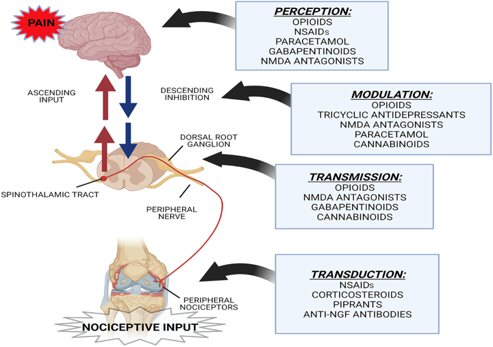
A useful way
to understand this is to think of pain in four stages: transduction,
transmission, modulation and perception.
-
Transduction is the
first stage. This is where inflammation or damage in the joint stimulates
pain-sensing nerve endings, called nociceptors. In an arthritic joint,
cartilage damage, synovial inflammation, bone changes and soft tissue strain
can all contribute to this local pain signal. Medications such as NSAIDs,
corticosteroids, piprants and anti-NGF antibodies can work at this level by
reducing inflammatory pain or blocking pain signals from being generated in
the first place.
 NSAIDs
(like Metacam) are commonly used in canine arthritis because they reduce
inflammatory chemicals called prostaglandins. Piprants, such as Grapiprant (galiprant)
, work slightly differently by targeting a specific prostaglandin receptor
involved in pain. Anti-NGF antibodies, such as Bedinvetmab (Llibrella),
target nerve growth factor, an important pain-signalling molecule in
osteoarthritis. NSAIDs
(like Metacam) are commonly used in canine arthritis because they reduce
inflammatory chemicals called prostaglandins. Piprants, such as Grapiprant (galiprant)
, work slightly differently by targeting a specific prostaglandin receptor
involved in pain. Anti-NGF antibodies, such as Bedinvetmab (Llibrella),
target nerve growth factor, an important pain-signalling molecule in
osteoarthritis.
-
Transmission is the
next stage. Once the pain signal has been created, it travels along
peripheral nerves to the spinal cord. Drugs such as Gabapentin, NMDA
antagonists, opioids and, in some situations, cannabinoid-based medicines
like CBD, may influence this movement of pain signals through the nervous
system. These drugs are often considered when pain has become more complex,
chronic or neuropathic.
-
Modulation happens
mainly in the spinal cord and brainstem. This is where the body can either
turn pain signals up or turn them down. In chronic arthritis, the nervous
system can become sensitised, meaning the dog feels more pain than expected
from the original joint problem. This is sometimes called central
sensitisation. Medications such as Gabapentin, Tricyclic antidepressants,
NMDA antagonists, Paracetamol and some opioid drugs may help modify this
amplified pain response.
-
Perception is the
final stage. This is when the brain receives and interprets the pain signal.
This is why pain is not just a mechanical problem, It affects behaviour,
mood, sleep, confidence and willingness to move. A dog with long-term
arthritis may become quieter, reluctant to jump, slower on walks, less
playful, or less enthusiastic about agility. Some medications influence this
higher-level perception of pain, helping the dog feel more comfortable
overall.
For agility dogs, this matters enormously.
These dogs are athletes. They need comfort,
co-ordination, confidence and freedom of movement. Pain can affect performance
long before obvious lameness appears. You may notice slower weave entries,
knocked poles, wider turns, hesitation before jumping, or reduced enthusiasm
after training.
Medication is
only one part of the arthritis plan. The best results usually come from
combining pain control with weight management, targeted exercise, physiotherapy,
strength work, joint supplements where appropriate, and sometimes intra-articular
or regenerative treatments such as PRP, hyaluronic acid, polyacrylamide hydrogel
or stem cell therapy.
Every dog is
different.
At Stem Cell
Vet, we often see dogs who are already on medication but still not moving as
well as they could. In these cases, the question is not simply 'which painkiller
should we use?' but 'where is the pain coming from, which parts of the pain
pathway are involved, and what else can we do to improve the joint environment?
Some do well with a single anti-inflammatory. Others need a layered
approach. Some need medication while they lose weight or build strength. Others
may benefit from regenerative intra-articular or joint-targeted therapies to
reduce reliance on long-term drugs.
The key
message is this: if your vet prescribes different medications for arthritis,
there may be a good reason. Arthritis pain is complex, and good treatment often
means targeting pain at several points, from the sore joint itself, through the
nerves and spinal cord, all the way to the brain.
Used
carefully and reviewed regularly, these medicines can help arthritic agility
dogs stay comfortable, active and able to enjoy the work they love.

Author credit...
Dr Stewart
Halperin BVMS MRCVS is a veterinary surgeon and the
founder of Stem Cell Vet, an expert veterinary service dedicated to helping dogs
with arthritis, joint pain and mobility problems. Stem Cell Vet sees dogs from
all over the UK who need help with arthritis, mobility and joint issues.
His interest in canine
arthritis began in a deeply personal way after losing his first dog, Benji, to
hip arthritis, after being told by specialist vets that nothing more could be
done, an experience that shaped his determination to find better ways to help
dogs stay comfortable, active and enjoying life for as long as possible.
Through Stem Cell Vet,
Stewart and his team focus on advanced arthritis care, using a unique multimodal
approach, including regenerative therapies such as stem cell treatment, PRP,
joint fluid replacement and tailored mobility support. Stem Cell Vet has helped
over 1,700 dogs across the UK with osteoarthritis and joint-related lameness,
with the sole emphasis on improving comfort, movement and quality of life.
He
has published three double blind peer reviewed studies on the use of stem cell
therapy in canine arthritis which can be found
here .
Stewart is passionate
about helping owners understand that stiffness, slowing down and reduced
mobility are not always 'just old age.' Even when owners have been told there is
nothing more that can be done, his view is that there is usually something more
that Stem Cell Vet can do to relieve pain, improve mobility and help our dogs
enjoy a better quality of life.
For more
information go to the Stem Cell Vet
website or email.
First published
19th August 2026
We say ‘ Pain is in the
Brain’
| |
|