| |
Why this keeps
happening...
 You've
walked the course, you have a plan, you lead out, you turn around… and your dog
is already gone. Or creeping. Or screaming at you. Or it's standing there
looking like they've never seen an agility course in their life. Startlines are
one of the most common struggles in agility, and doing more of them isn't what
fixes it. Erica van Manen explains what's happening and what you can do about
it. You've
walked the course, you have a plan, you lead out, you turn around… and your dog
is already gone. Or creeping. Or screaming at you. Or it's standing there
looking like they've never seen an agility course in their life. Startlines are
one of the most common struggles in agility, and doing more of them isn't what
fixes it. Erica van Manen explains what's happening and what you can do about
it.
It comes down to your dog's state of mind
when they get to the start. Some dogs wind themselves up so much that by the
time you step away they simply cannot hold it together, and they break, creep or
bark before you've even turned around. Others go the other way. Busy rings,
waiting around, dogs running nearby, noise, the pressure of the environment is
too much.
They slow down, hesitate or switch off entirely. Two very different pictures,
same result i.e. a startline you can't rely on.
And if your dog can't hold it in training
or at a quieter session, they are not suddenly going to produce one at a show.
What most
handlers do...
Most handlers repeat the same startline over and over,
hoping something will change. They swap things around, try a different position,
a different cue, a different routine, then switch back again when that doesn't
work either. They let it slide when they're rushed or fed up and just want to
get on and run. There might be the odd good one, then the environment gets
harder and it falls apart again.
What
actually makes the difference...
Everything around the run feeds into the startline. If
your dog struggles to watch agility from ringside, they'll struggle to queue. If
they struggle to queue, they arrive at the start already in the wrong state. The
startline is one moment, but it reflects everything that came before it. What
actually needs work is arousal control, focus in agility environments and a
consistent routine from the moment you arrive at the venue.
Where to start...
Your queuing routine is where most startlines are won or lost, and
it's the easiest place to begin.
Here's a simple four-step structure that
works well for most dogs:-
- Release excess energy before you head
ringside, which could be a tug game or a run in the exercise area.
- Warm up so your dog is physically
ready for the run. Your physio can help you with a routine that suits your
dog.
- Do nothing. Your dog learns to relax
quietly while you look at the course and get your head together. This is
where a lot of dogs struggle, but it's a skill worth taking the time to work
on.
- Practice your startline. One or two
repetitions before you go in, the same way each time.
When that routine is consistent, you walk
into the ring feeling confident, and your dog comes in able to focus and
respond.
If your startline is something you dread
rather than trust, that's exactly what I work on with handlers.
www.ericavanmanen.com
 About
the author... About
the author...
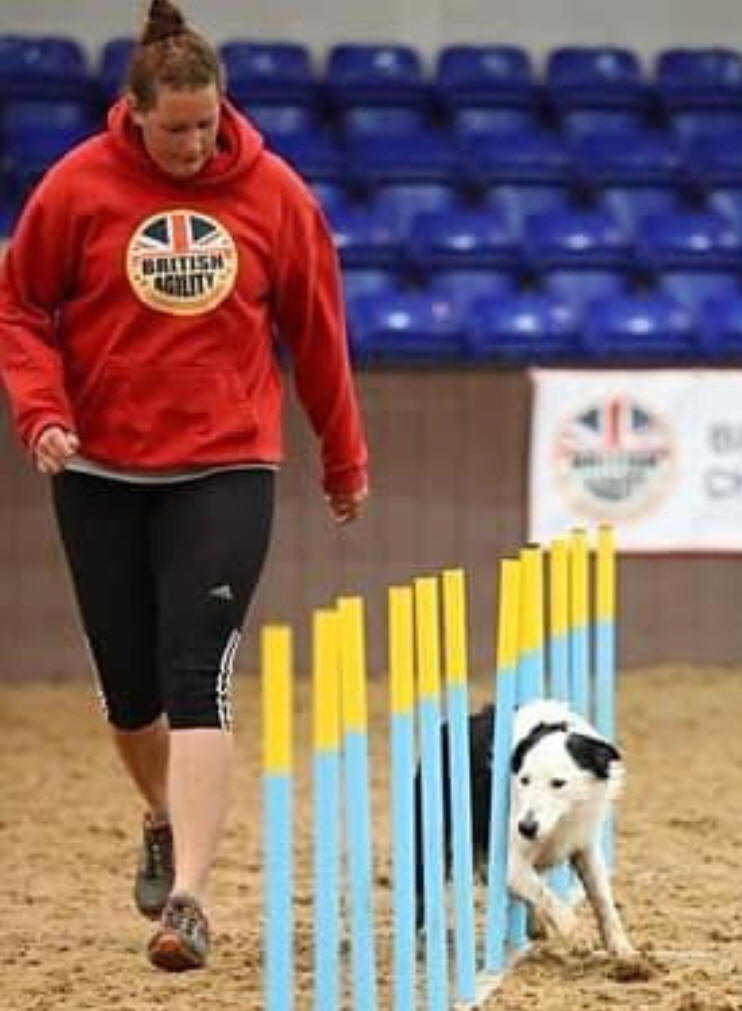
Erica van Manen is a dog trainer
and behaviour specialist with over 20 years of experience working with pet dogs,
agility dogs, rescue dogs and assistance dogs. She specialises in behaviour for
agility dogs, helping handlers with problems such as barking, over arousal, lack
of focus, startlines, and ring stress.
Erica has a BSc (Hons) in Animal Behaviour
and Welfare and runs her own business providing online coaching and behaviour
support for dog owners and agility handlers.
Website: https://www.ericavanmanen.com
Email
ericavanmanen@outlook.com
First published 23rd April 2026
| |
|